The Guanaco
Lama guanicoe
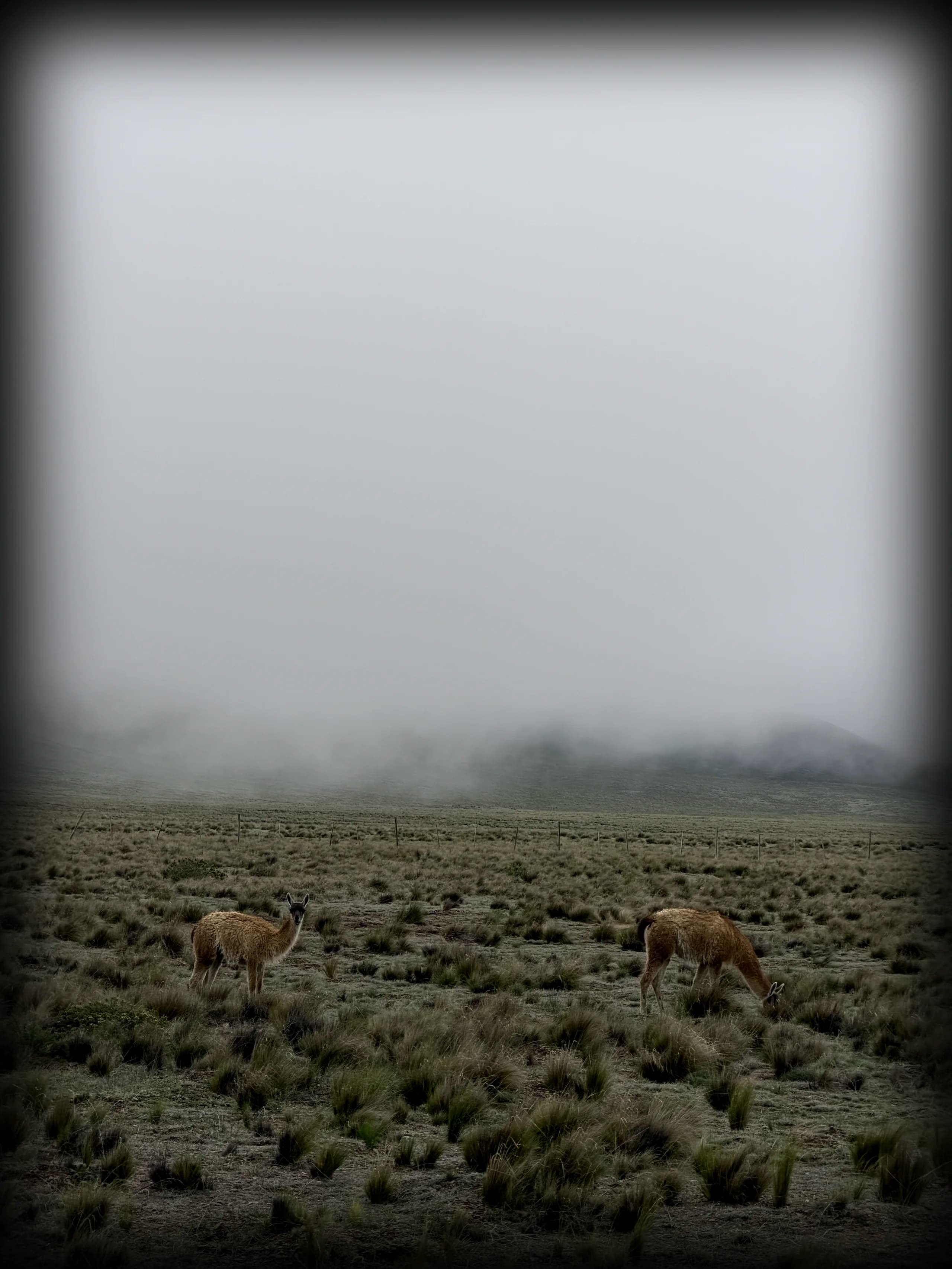
A wild camelid native to the southern Andes and the Patagonian steppe. Related to the vicuña, ancestor of the llama. Standing nearly four feet at the shoulder, with a rich cinnamon coat and white underbelly that vanishes against the scrubland.
They roam from sea level to 13,000 feet. Their blood carries more red blood cells than any comparable mammal—an adaptation to the thin mountain air of the Andes. They run at 35 miles per hour over terrain that would slow a horse. They've inhabited these lands for two million years.
Once, there were 50 million. Spanish colonization, sheep farming, and habitat loss reduced that number by 97%. Today, roughly 1.5 to 2 million remain, mostly in Argentina. They are protected under CITES Appendix II.
14 Microns
Beneath the guanaco's coarse outer coat lies a down undercoat of extraordinary fineness: 14–18 microns in diameter. For context, a human hair is 70 microns. This places guanaco fiber among the finest natural fibers on earth—comparable to the best cashmere, approaching vicuña.
Thermoregulating
Insulates in cold, breathes in heat. The hollow fiber structure creates natural temperature regulation.
Water Resistant
Natural oils in the fiber repel moisture without any chemical treatment.
Moisture Wicking
Transports moisture away from the body faster than sheep’s wool.
Naturally Clean
Resistant to dirt and odor. The fiber’s natural oils limit the need for washing, extending garment life.
Ultralight
Exceptional warmth-to-weight ratio. Lighter than cashmere at equivalent warmth.
Durable
Outlasts cashmere significantly. Resistant to pilling and abrasion despite its fineness.
How It Compares
Select a property to compare guanaco fiber against other rare natural fibers.
Fiber diameter in microns. Lower values indicate finer, softer fiber.
For this property, lower raw values indicate superior performance.
Usable fiber per animal
A single guanaco produces 400–600 grams of raw fleece when sheared. After the labor-intensive process of separating the fine undercoat from the coarse guard hairs, only 150–250 grams of usable fiber remain. That's less than half a pound, from a wild animal that can only be sheared every two to three years.
For comparison: a cashmere goat produces roughly 200 grams of fiber annually. A single merino sheep produces 4–5 kilograms. The math of scarcity is simple.
This is why we cannot produce at scale—and wouldn't if we could.
Chaccu
Guanaco fiber cannot be farmed. The animals are wild and protected. Harvesting follows the chaccu—an ancient Andean tradition dating to the Inca empire. Once a year, communities build temporary corrals of nets across the guanaco's migration routes. The animals are gently guided in, shorn by hand, and released.
No animal is harmed. No herd is disrupted. The practice is regulated by Argentine wildlife authorities and CITES. It is, by necessity and by choice, small-scale. Just setting up a camp for the shearing costs roughly $19,000.
This is a ritual that predates modern luxury by centuries. When we say our fiber is “woven from the wild,” this is what we mean.
Hands of Patagonia
The fiber is processed by artisans in Argentina who have inherited their craft across generations. Some work on hand-looms dating to the 19th century. The tradition of working with camelid fiber is inseparable from the culture of the gaucho—the Argentine horseman of the plains—and the indigenous communities of the Andes.
The poncho—Argentina's main artisanal product—has been handmade from guanaco and vicuña wool for centuries, using processes and techniques handed down through generations with local and natural raw materials. A single garment can take one to four months to complete.
From the raw fleece to the finished yarn, every step involves human judgment and skill that no machine can replicate. This is luxury measured in hands, not units.